

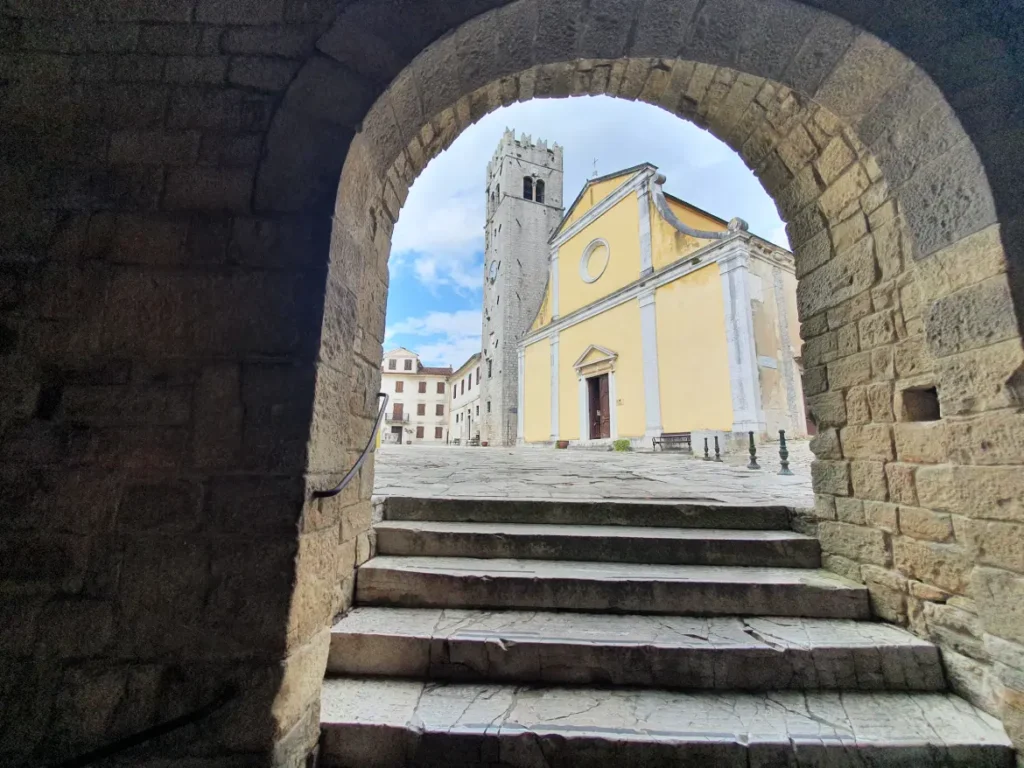
Set above the magnificent Mirna River, lengthening its flow around the valley, Motovun is scenic and vivid.
Motovun is an old, picturesque fortified town, first mentioned in the 12th century. Surrounded by green Istrian vineyards and forests under the hills, known for black and white truffles, I would say Motovun is the most visited picturesque place in central Istria.
Why should you visit Motovun?
Motovun is an ideal place if you are looking to skip the most popular summer tourist hotspots in Croatia. If so, you should not miss Motovun while strolling the Istrian roads passing by its hills and forests. The photographers will like Motovun, home to one of Istria’s most famous photo spots. Many artists and photographers will feel inspired to create in Motovun, too. Precisely, many of them would make works in those forms that would never be forgotten.
Trek Goat was on the spot and always got inspired while visiting the picturesque places of Istria, such as Motovun. When I arrived in medieval Motovun for the first time as a kid on an elementary school visit, I couldn’t imagine what historical significance lay hidden there. Soon after I grew up and started to learn more about the heritage, I realised this town is a perfect architectural masterpiece. However, the thing which never changed was the stunning view extending to the green valley. Such is the case, and I will always remember it the same way I did when I visited the place for the first time. Every time I revisit the site, this view reminds me of what I saw as a kid, and I am still happy to enjoy it through the eyes of those children from my first visit.
5 Things to do in Motovun
You are on the right track to keep on reading this article about Motovun, a small, charming hilltop place nestled in central Istria! Even though a Trek Goat does not drink as much wine, let’s try some truffles and exceptional food. All of it, too, for a perfect escape we listed for you below. Motovun has a population of about 600. Still, it has been visited every day by more renowned European artists. Here are 5 essential things to do. So get a ride on a steep yet paved road to reach the small town and begin a tour.
While tasting Motovun’s renowned truffles, enjoy the views and local legends. Take photos, explore actively, and refresh yourself in the area’s clean air.
1. Enjoy the Josef Ressel Square viewpoint
The beautiful, picturesque square of the Josef Ressel is something you’ll first mention once you climb up to the town. The picturesque square is named after Josef Ressel (1793-1857), an Austrian-Czech forester who invented a ship propeller and worked in Motovun. A square also had strategic importance, as it lies in a vast open space leading to the city’s oldest part. It connected the outer and inner city gates. A visitor wouldn’t miss the view from the square. Take a seat and enjoy the green landscapes while tasting a glass of Istrian Malvasia or Merlot. My favourite time to be there is sunset.
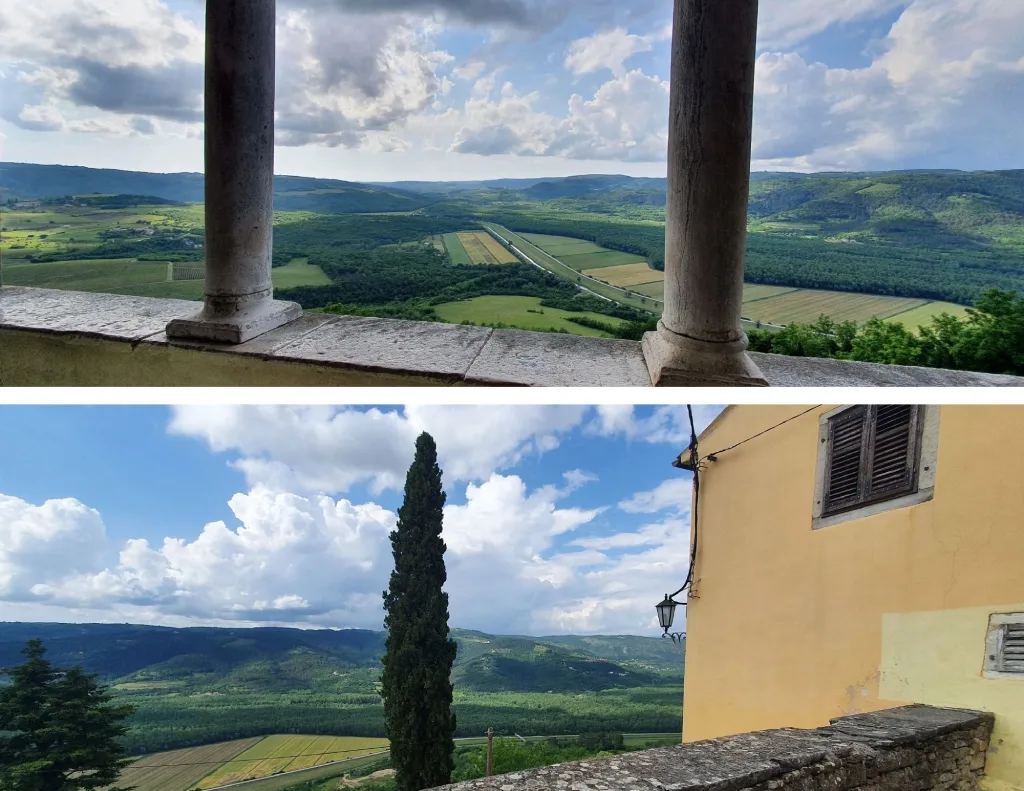
One of the features there is also the awesomeVenetian loggia. Once, it served as a place of justice. Under its roof, decisions were made public to the people, and judges were making their decisions. The loggia has been a favourite place for many generations of young Motovun, walking into the sunset and sharing their first shy love glimpsed right in the town lodge. You shouldn’t miss taking a photo of it. A loggia was first mentioned in 1331 as a public place called “Lobia Maior“, but it is not even known whether it was located there.
2. Stroll the Andrea Antico Square
The central town square is named after the Renaissance composer and musician born in Motovun. A square is bounded by the Baroque St.Stephen Church, Municipal Palace, and the Communal Palace.
Local tip. Find some artistic points. Motovun is where the artists will find their place. One of the artistic features is the cistern located right on the A. Antico square. A cistern once served as a water supply for Motovun. So it was practically one of the medieval town’s key elements. The cisterns, called “šterna” by locals, were of great importance in Istria. This well, dating to the 15th century, is located in the northern part of the square.
3. Walk along the city walls and enjoy the view
You simply cannot miss the most important thing while in Motovun. And of course, I mean walking alongside its strategic defensive walls. In 1278, when the city was taken over by the Venetian Republic, solid walls were built. The towers and city gates contain elements of Romanesque, Gothic, and Renaissance architecture. To get the best unobstructed views of the valley below, you’ll need to buy a ticket. Except during the wintertime. Once you come to the city walls promenade, you will be able to walk on them and enjoy the view as much as you like. The number of visitors will depend on the year and season. Still, I like to say you’ll be mostly out of the hustle & bustle compared to those other major destinations. As I found, just a few couples were with us the whole time, and we were walking the walls in the middle of them.
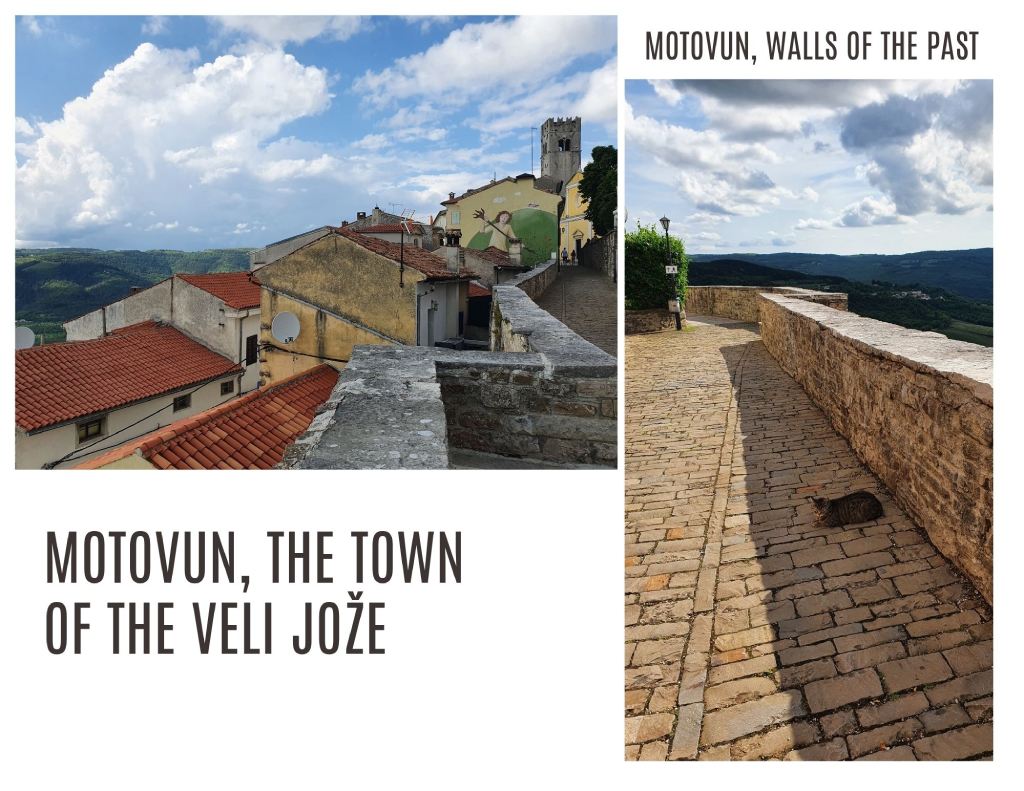
To feel mystical, get strolling the picturesque Motovun walls with a hidden past, from their vantage points. There you will enjoy a magnificent view of the vineyards, the Mirna Valley and St. Mark’s Forest. Though the view from the walls of Motovun is incredibly stunning, I have to uncover one truth. Motovun can be very foggy in the mornings. But this is precisely when a city surrounded by sun and fog is the best place to photograph.
Local tip: search for the legend of happiness. According to legend, the Motovun castle lies atop an ancient energy source that keeps its residents always happy. Taking all this into consideration, the myth might be right.
4. Capture the Motovun bell tower
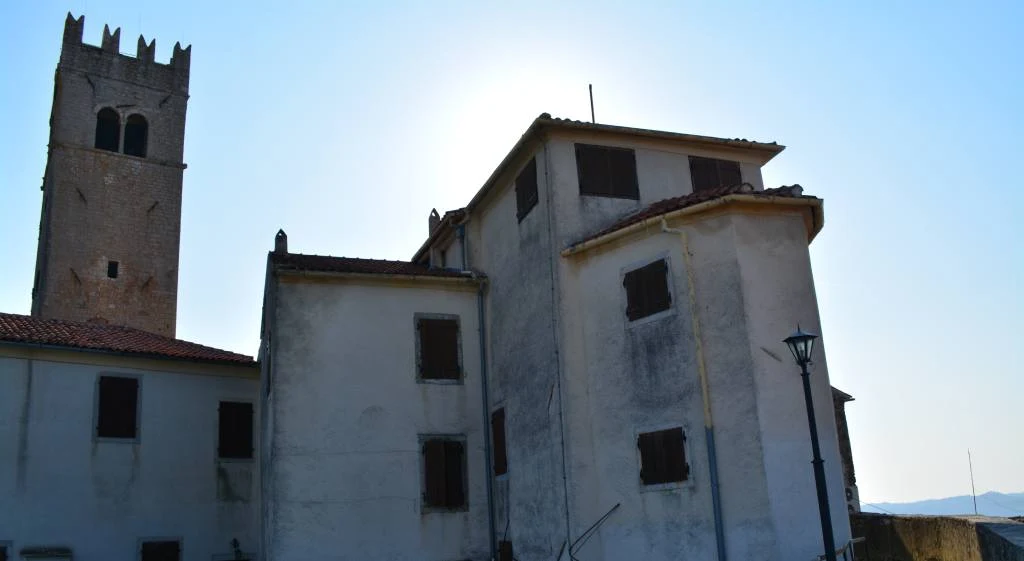
You simply cannot miss the chance to take beautiful photos of a 27-metre-high Romanesque-Gothic bell tower. A crenulated crown building dominates the medieval city and the entire landscape of the middle part of the Mirna River Valley. It looks like a knight from the bottom of the hill, and it is one of the most common patterns on Motovun postcards.
A building built in the 13th century had mainly a defensiveand observation purpose, but it has been rebuilt several times. Eventually, it was rebuilt to serve as a bell tower. The last restoration from 1528 is also testified by the inscription.
5. Stroll the Narrow Streets and find some Handmade
Motovun’s narrow cobblestone streets are so picturesque. One can spend at least an hour, or even a few, walking, taking photos of coloured houses, walls, or beautiful vistas. But you can also spend another hour browsing the Istrian handmade shops with plenty of gallery-style goods for sale. Many of them offer the items as handmade souvenirs, truffles, wines, or othersimilar products.
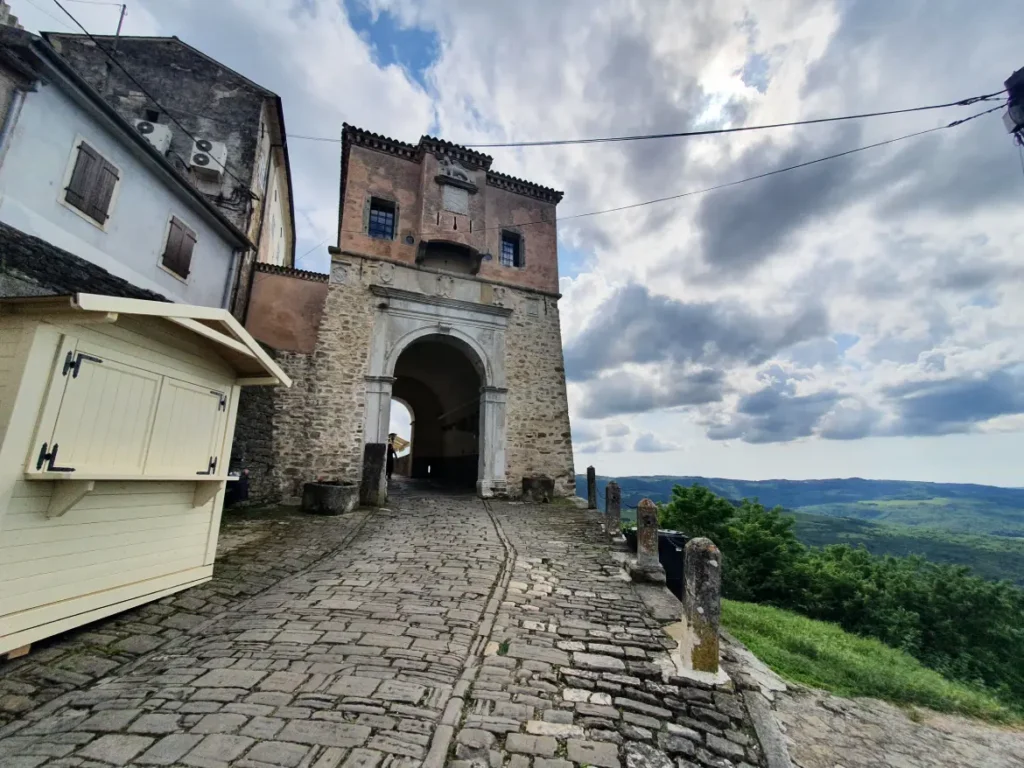
Motovun consists of three parts – the oldest, with upper walls at the top, Podgrđe below it, and Gradizol. A very attractive area to walk in is Gradiziol, a suburb of Motovun, located at the old town’s foothill. An area dating back to the 14th century takes on its appearance during the 18th century. It is believed that this part of the city was guarded by a series of tall houses, built on the north side.
Local tip: Climb the 1000 Stairs. Those who like sports can climb Motovun on foot via the 1000 steps leading straight to Motovun Hill’s top. Climb up to the top of the mountain and enjoy the picturesque scenery.
Bonus thing to do in Motovun: Learn about Veli Jože’s legend
Motovun is known in today’s Istrian population as the city of Veli Jože. The good gentle giant is a character in a novel by the Croatian author Vladimir Nazor, one of the most important Croatian writers of the 20th century.
First published in 1908, the novel is set on the Istrian peninsula during the Venetian period and tells the story of Jože, a friendly, good-hearted giant. Veli Jože is one of Vladimir Nazor’s most famous works. The tale has become known throughout Croatia, while the character of Veli Jože (Big Joe) is quite correctly linked with the city of Motovun.
Motovun sights
Though it may seem tiny, once you climb up to the top of the hill, you’ll notice that Motovun has a few historical monuments. Many historians would agree that Motovun is one of the most preserved defensive castles in Istria. The place grew up on the site of an ancient city called Castellieri. It’s assumed the settlement developed for the first time on the hill before the Roman era. Then the Gradina was owned by the Celts or the Sekusi tribe. It is believed that the Slavic name Motovun was influenced by the Croatian dialect. At the turn of the 19th century, a tombstone was found in Novigrad with the inscription “Montona Rustica”. Here are some of the sights.
The Tower – Northern Gate
The tower, also known as the Renaissance Northern Gate, dating back to the 9th century, was of significant importance to the city. It overlooked the road towards the ring of defence walls, leading to the interior walls called “Muraje“, dating back to the 13th century. Those surrounded the city’s oldest part. According to the superscription, the exit gateway was restored in 1607, during the government of the Podestà. Inside the passage, there is a lapidary with a Venetian lion and a coat of arms with 5 towers.
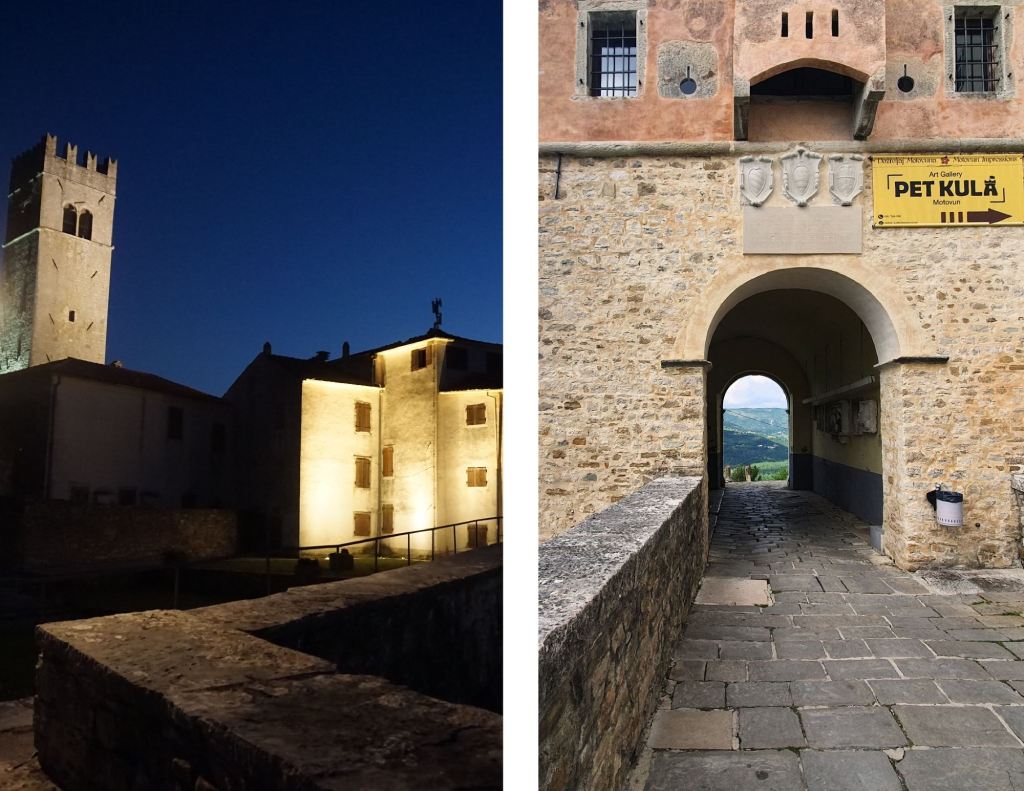
While passing the gate and feeling like a knight in one of the few well-preserved medieval castle systems, I would like to mention that Motovun had two rings of defensive walls. Such a contribution is significantly maintained today.
St.Stephen Church
The Parish church of St. Stephen, located on Antica Square, is a three-nave basilica. It was built on the remains of a previous church, most likely on the foundations of an ancient basilica. According to the legend, the margrave Engelbert of Istria and his wife, Countess Matilda, were buried in the older church. The present-day church was built from 1580 to 1614, while its current form only emerged in the 18th century. Italian architect Andrea Palladio is renowned for it. The three marble altars are inside the church, along with one precious wooden altar. On the main altar are statues of St. Stephen and Lorenzo, a work by Francesco Banani in 1735. The church also saves sacred collections as candlesticks.
The Municipal Palace
The impressive Municipal Palace can be easily noticed upon entering the space between the inside and outside town Gates. It is one of the best-preserved Romanesque public buildings not only in Istria but in Croatia. Besides Romanesque, it also has Gothic-style features, similar to the remains of Romanesque and Gothic houses in Motovun. The palace was first mentioned as a medieval fortification dating from the 13th century. In addition to its public function, it also served as an essential part of the city’s defence as a city hall during the same period.
Polesini Palace
A building located at the very top of the town dates back to the 18th century. Today, it serves as the Boutique Hotel Kaštel. The building was home to Motovun’s most affluent patrician family, which controlled large, fertile landholdings around Zamask, Motovunski Novaki, and Poreč. The Polesini family was given the title of Marquis in the 18thcentury, and various prominent persons and intellectuals were.
The Church of the Blessed Virgin Mary
Located at the entrance to the foothills, the church dates back to the 16th century. In 1595, the Servites founded their convent next to the cathedral and lived there until 1790. The 15-meter-high bell tower next to the church appears very picturesque. It was added in 1749. The church floor contains a variety of graveyards belonging to prominent Motovun families.
The old Pharmacy Building – Hospice
During the Middle Ages, almshouses or homes for the elderly also operated in Motovun. A small team of a doctor and a pharmacist was working in the town as early as 1331. It’s unknown how often the doctor worked from the hospice. There is evidence that the hospice, rebuilt in 1622, was managed by a psychiatrist hired by the community and a surgeon.
A foothill area main gate
The principal city gate leads from the lower square to the citadel, the city’s oldest portion. The gate’s vaulted opening opens into the “outer square.” This mighty gate and its high tower, established in the 16th century, provided people protection and prevented potential invaders from reaching the area. Merchants and agricultural workers from nearby villages were clumping along this arched corridor, carrying their boots, in deference to the significance and strength of the aristocracy who resided in the citadel.
St.Anthony of Padua/St.Cyprian church
The fascinating church named after two saintswas first mentioned as early as 1454. During the 19thcentury, the church was extensively rebuilt and honoured with votive contributions from locals. Saint Cyprian is believed to be a protector against the plague. For that purpose, it is evident that a church devoted to him, as in some other medieval towns, was constructed at the town entrance. Then, it was believed, that this would prevent the horrible plague disease from entering and breaking out in the city.
Motovun outdoor
Now, when you finish the history tour and if you have time outdoors, I’d say let’s go! You simply cannot be an outdoor fan and not taste one of the mystical paths surrounding Motovun.
Motovun Cycling
If you don’t have your bicycle, don’t care. You can rent itto ride out into the countryside. You can hire anything you need from tour operators in Motovun, including helmets and safety equipment. There are a few of the most famous bicycle tours: Voćni put (Fruit Trail), Stara Ferata (Old railway) and Veli Jože. Take a look at the Tourist Board while there for details.
By bike: A cycling tour alongside the Mirna River. One of my favourite cycling tours of Istria is undoubtedly the trail alongsidethe Mirna River. A 57 km-long trail runs alongside the riverbanks, overlooking the Motovun hill. The Mirna River is the longest river on the Istrian peninsula. It springs next to Hum, the smallest place in the world and flows till the river mouth of the Antenal next to Novigrad. There it spills into the sea.
An ancient beaten path will reveal traces of Roman times. Before that time, the ships sailed alongside the River Mirna from Antenal at Buzet’s foot. However, the river’s size changed during geological shifts, and the water level has also changed. Even though it is no longer used for water transport, you can still see the old lighthouses with doors and pits at the bottom used for fire. Their light could be seen during the stormy winter nights from the river and the sea.
By bike: Parenzana. A former railway, which opened in 1902, today makes a 123-kilometre-long cycle track, crossing 11 bridges, 6 viaducts, and passing through 9 tunnels. The railway, which used to connect Trieste and Poreč, was affected by the appearance of cheaper transport. So it should be closed. After its tracks were soon removed, the infrastructure lasted.
Motovun hike& walk
Walking fans would like the Motovun area. The natural beauty and surroundings of the Mirna Valley, the Motovun forest, and the old Parenzana rail line are made for walking.
Trek Goat walking Tip: Walk the Motovun Forest. One of my favourite autumn activities is to breathe the air of Motovun forest, situated in the alluvial ground along the Mirna valley. A walk along the Motovun Forest will let out the intrinsic habitat in the world: a white truffle (Tuber Magnatum Pico).
Get a breath of its air under the shadow of ancient deciduous trees. The typical native tree species in this forest is the pedunculate oak (Quercus robur), native to the lower parts of mainland Croatia. The Motovun Forest was considered during the Austro-Hungarian Monarchy a reserve dedicated to the growing of wood, securing the supply for shipyards and building timber.
Motovun events
There are a few of them during the year.
The Festival of Teran Wine and Truffles
Suppose you are in Istria on the last Saturday in September and you want to taste some wine. In that case, you simply cannot miss this one-day public wine-tasting exhibition. And not just the wine. It’s a Teran wine, one of the good wines by locals in Istria. Yes, this type is produced in the surroundings of Motovun. The Festival also exhibits truffles and truffle tasting. Look for the biggest one that is awarded the title “Veli Jože”. Do you know the biggest could grow as heavy as 500 grams?
“Igra Na Roh” (Throwing of the Horn)
A unique yet simple traditional game has been played in Motovun on Ash Wednesday, the first day of Lent, every year. There are simple rules: one of the players throws an ox’s horn, and the others attempt to throw their wooden bats or ‘Bačuke’ as close as possible to it. The winner is the one who gets closest to the horn.
Motovun Film Festival (Cinehill)
Culture and movie buffs will enjoy the Motovun Film Festival, held every summer since 1999. Motovun Film Festival, now known as Cinehill, is no longer held in Motovun but has moved to the scenic locations of Gorski Kotar. Since 1999, it has attracted film and culture lovers with its rich summer program. If you’re in the region in late July, don’t miss the open-air evening screenings and all-day film marathons—from morning until past midnight—that now continue in the refreshing mountain atmosphere of Cinehill.
Getting to Motovun
✈️ Air.
- Pula Airport – About 75 km from Motovun, the nearest airport.
- Rijeka Airport – 95 km away, approx. 1.5 hours by car (traffic permitting).
- Trieste Airport (Italy) – About 110 km.
- Venice Marco Polo Airport (Italy) – 220 km away.
- Zagreb Airport – 270 km.
- Ljubljana Airport – Another option, further away.
🚌 By Bus. The nearest major bus station is in Pazin. From there, a local bus or taxi is needed to reach Motovun.
🚂 By Train. The nearest train stations are in Buzet or Koper. A private transfer or taxi is required for the last ~20 km to Motovun.
🅿️ Parking. Motovun is tiny but increasingly popular. Several parking areas are available at the foothill entrance.
- Cars are not allowed in the town centre.
- Parking is paid during the summer.
- A local shuttle bus connects the parking areas to the town entrance.
🌄 Daily tours from Motovun. Motovun is part of Istria’s charming network of hill towns, along with Oprtalj, Zrenj, Buzet, Buje, Žminj, and others. It’s a great base for exploring the beauty of Istria.
Motovun tips
📍 Where it lies: Central Istria, 20 km from Pazin, above the Mirna River valley.
🚶 Wander: Josef Ressel Square, Venetian loggia, and the panoramic city walls.
⛪ Sacred corners: St. Stephen’s Church with its Romanesque bell tower; Church of the Blessed Virgin Mary at the foothill.
💧 Hidden gems: Motovun Forest and Parenzana Trail — perfect for walking or cycling through truffle country.
🅿️ Practical: Car-free centre; paid parking at the foothill with a shuttle to the old Tpula Airport: 75 km, Trieste: 110 km, Zagreb: 270 km. 0 km.
🐐 Trek Goat tip: Visit early morning or at sunset — when fog and golden light meet over the valley, Motovun feels like it’s floating between worlds.